
PRISM
Probing Reasoning, Instruction, and Source Memory
in LLM Hallucinations





Abstract
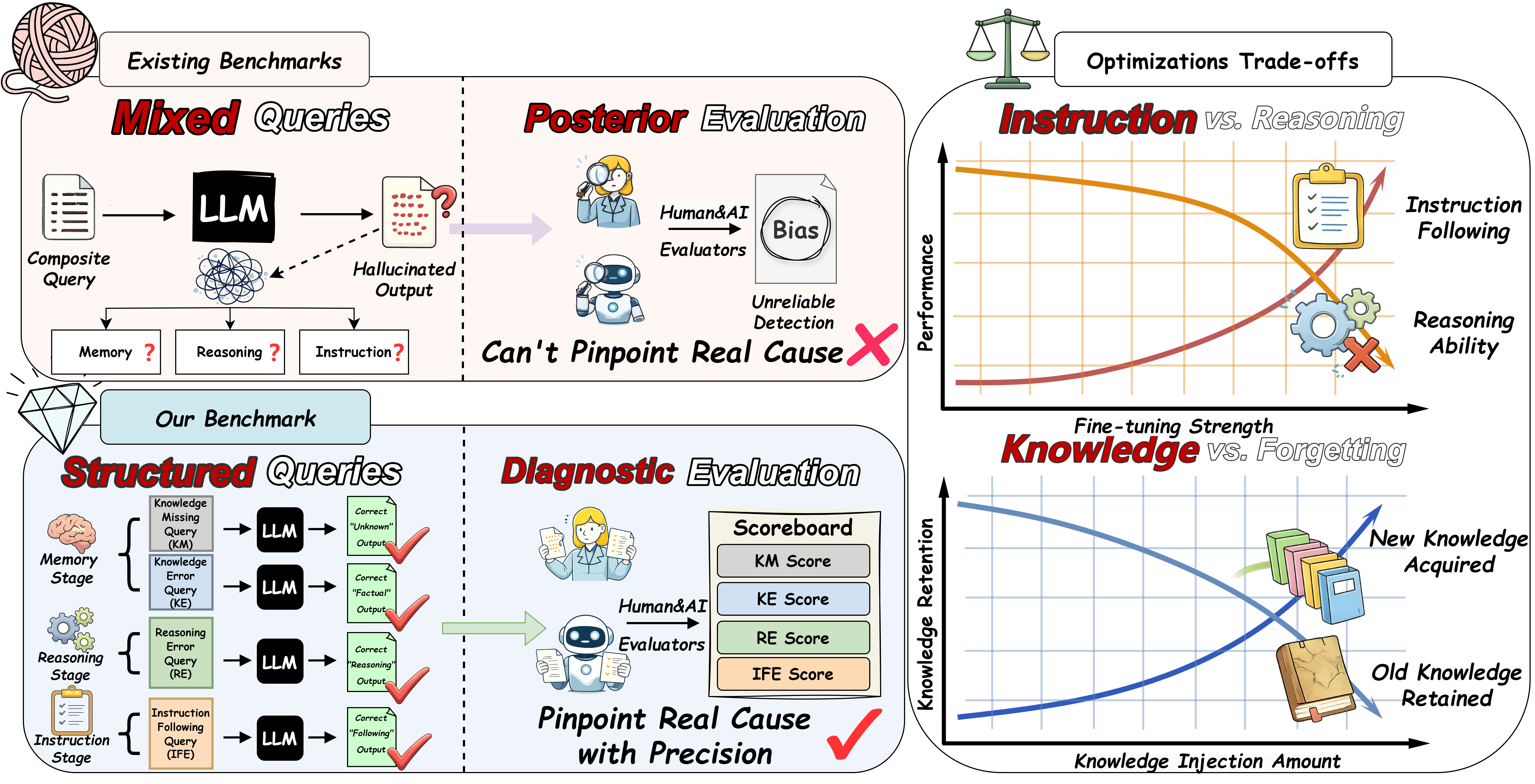
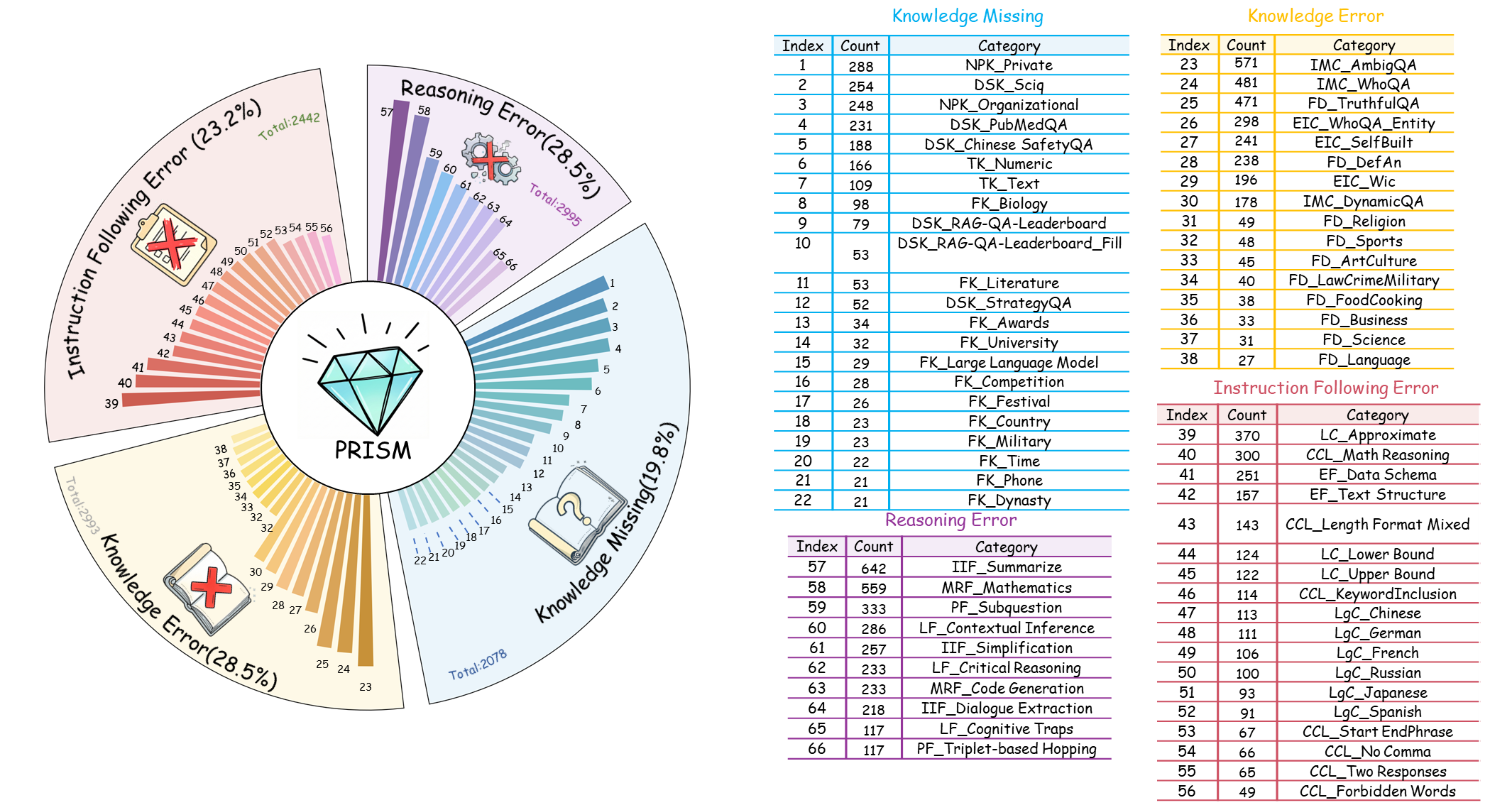
As large language models (LLMs) evolve from conversational assistants into agents capable of handling complex tasks, they are increasingly deployed in high-risk domains. However, existing benchmarks largely rely on mixed queries and posterior evaluation, which quantifies hallucination severity but offers limited insight into where and why hallucinations arise in the generation pipeline. We therefore reformulate hallucination evaluation as a diagnostic problem and propose PRISM, a controlled benchmark that disentangles hallucinations into four dimensions: knowledge missing, knowledge errors, reasoning errors, and instruction-following errors, grounded in three stages of generation (memory, instruction, and reasoning). PRISM contains 9,448 instances across 65 tasks and supports fine-grained, stage-aware diagnostic evaluation. Evaluating 24 mainstream open-source and proprietary LLMs, we uncover consistent trade-offs across instruction following, memory retrieval, and logical reasoning, showing that mitigation strategies often improve specific dimensions at the expense of others.
Framework Overview
PRISM's structured query design and diagnostic evaluation pipeline.
| Model | 𝓗-Score | KE | KM | RE | IFE | Size | Think |
|---|
PRISM [ACL 2026]
@inproceedings{wu2026prism,
  title     = {PRISM: Probing Reasoning, Instruction, and Source Memory in LLM Hallucinations},
  author    = {Wu, Yuhe and Wang, Guangyu and Chen, Yuran and Zhang, Jiatong and Zhang, Yutong and Chen, Yujie and Shang, Jiaming and Zhang, Guang and Liu, Zhuang},
  booktitle = {Proceedings of the 64th Annual Meeting of the Association for Computational Linguistics (ACL)},
  year      = {2026}
}
For general inquiries about PRISM, please email: